Spiral hand-tied: 18° spiral, binding at 28% of stem length, stems 1.6× the vase
· Published 2026-09-04 · Bouquet structures
The spiral is the only bouquet structure in this archive that holds itself up without a grid, a pin holder or floral foam. Its stability comes entirely from geometry: every stem crosses every other stem exactly once, and the resulting lattice carries the load.
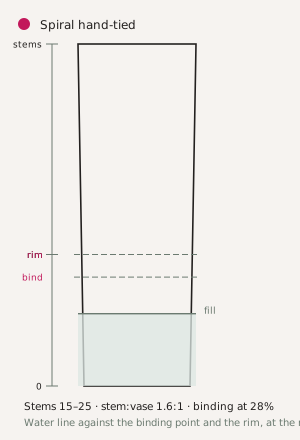
Spiral 18° Binding point 0.28 Support None (self-supporting) Stem count 15–25 Stem : vase height 1.6
The 18° angle is what makes the lattice
Each stem is laid at roughly 18° to the previous one and rotated a quarter turn as you add it. At less than about 12° the stems run parallel and the bundle becomes a cylinder that rolls; at more than about 25° the crossings scatter and the head splays open.
The angle is measured between adjacent stems at the binding point, not at the flower heads. This is where most people go wrong — the heads should look dense while the binding point is visibly spiralled.
- Add each stem at 18° to the last and rotate the bunch a quarter turn between additions.
- Build in the left hand, add with the right, keep the binding point at eye level while you work.
- Every stem must cross every other stem exactly once — check by looking down the binding point.
- If the bunch rolls when you set it down, the angle is too shallow; pull the whole thing apart and start again.
Binding at 28% of the stem length
On a 500 mm stem the binding point sits at 140 mm from the cut ends. That ratio is the compromise between two failures: bind lower and the heads splay outward; bind higher and the stems below the tie have nothing holding them and the bouquet collapses in the vase.
Tie with raffia or a wide elastic band, never with wire. Wire cuts into the stems at exactly the point where they carry the most load.
| Binding ratio | Effect on a 500 mm stem | Result |
|---|---|---|
| 0.20 (100 mm) | heads splay 25–30° outward | unstable, wide |
| 0.28 (140 mm) | heads held at 8–10° | stable |
| 0.35 (175 mm) | stems below the tie splay | collapses in the vase |
| 0.45 (225 mm) | bundle too tight to open | crushed stems |
Stem count, vase ratio and the water
A spiral of 15–25 stems is the working range. Below 15 there are not enough crossings to lock the lattice; above 25 the inner stems are in darkness and the middle of the bunch will rot before the outside shows any symptom.
Stem length should be about 1.6 times the vase height. That puts roughly 60% of the stem above the rim, which is what makes a spiral read as a spiral rather than as a posy.
- Cut to 1.6× the vase height, then strip all leaves that would fall below the rim.
- Fill the vase to 10–12 cm; a spiral bunch takes up water along its whole length so a full vase is unnecessary.
- Recut 20 mm and re-tie if the bunch has been out of water for more than 30 minutes.
- For a mixed spiral, alternate a woody stem with a soft one every third position — the woody stems are what stop the lattice collapsing.