Grid-supported mixed bunch: 21–35 stems, 15° spiral plus a slotted grid, 1.8× the vase
· Published 2026-11-06 · Bouquet structures
This is the large-format structure in the archive — 21 to 35 stems — and it is the only one that uses two stabilising systems at once. The 15° spiral gives the inner lattice; the slotted grid holds the outer ring in place where the spiral alone is not enough.
Spiral 15° Binding point 0.3 Support Slotted grid Stem count 21–35 Stem : vase height 1.8
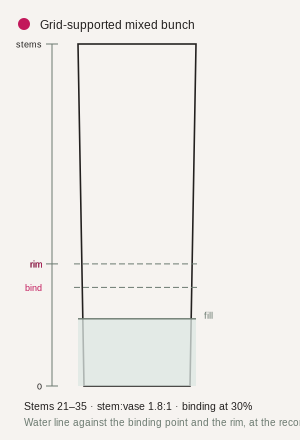
Why a big bunch needs both systems
Up to about 25 stems, a spiral at 18° is stable on its own. Past 25 the outer stems are further from the binding point and their crossings are under less compression, so the outer ring starts to lean outward in the vase. A slotted grid across the vase mouth takes that load off the spiral entirely.
The spiral also drops to 15° in this structure, not 18°: with a grid carrying the outer ring, a shallower angle keeps the bunch from becoming too tall and conical.
- Build the spiral at 15° as normal, then cut and set the grid before the bunch goes in the vase.
- Grid openings should be about 25 mm — large enough not to crush stems, small enough to hold each one.
- Always add the outermost stems first when arranging into the grid; pushing them in later splays the inner lattice.
- Uniform stiffness in the outer ring matters more than colour here.
Air movement is the hidden variable
A 21–35 stem bunch presents a large surface area and traps a pocket of still, humid air in its centre. At 20 °C and 60% relative humidity that pocket sits 2–3 °C warmer than the room and is the first place botrytis establishes.
The grid helps here as well: separating the stems allows air to move through the centre of the bunch rather than around it.
| Structure | Centre temperature rise | Botrytis by day 5 |
|---|---|---|
| 35 stems, grid | +1.5 °C | rare |
| 35 stems, no grid | +3 °C | likely in the centre |
| 35 stems, no grid, no air movement | +4 °C | almost certain |
| 21 stems, grid | +1 °C | rare |
Building order for a 30-stem bunch
Work in four passes: the woody structural stems first, the round focal flowers second, the filler third, the trailing foliage last. Building in that order means the heavy stems are already locked into the lattice before the soft ones go in, and you never have to push a woody stem through a mass of soft tissue.
The 1.8× ratio puts a 600 mm stem in a 330 mm vase — high enough that the outer ring is above eye level for a standing viewer, which is what gives a large bunch its presence.
- Pass 1: woody structural stems (eucalyptus, lilac, rose) — 8–10 stems.
- Pass 2: round focal flowers (chrysanthemum, carnation, lisianthus) — 8–10 stems.
- Pass 3: fillers (gypsophila, alstroemeria) — 6–8 stems.
- Pass 4: trailing foliage (leatherleaf, eucalyptus tips) — 4–6 stems.
- Recut every stem 20 mm immediately before it goes in; a 30-stem bunch takes long enough that the first stems dry if you cut them all at once.