Layered garden bunch: concentric rings, grid support, 9–15 stems at 1.3× the vase
· Published 2026-11-01 · Bouquet structures
The layered bunch is built in concentric rings rather than a spiral: one focal flower at the centre, then a ring of secondary flowers, then a ring of foliage. It is the structure that best shows off a wide, low vase — and the one that fails fastest if you skip the grid.
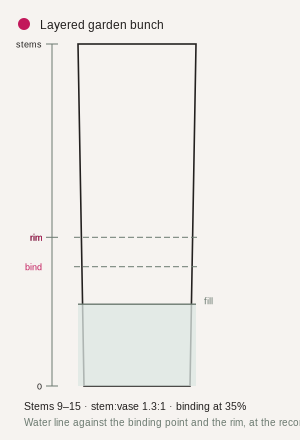
Layered 0° Binding point 0.35 Support Slotted grid Stem count 9–15 Stem : vase height 1.3
Rings, not a spiral
A layered bunch has no spiral angle at all; the stems stand almost parallel and the structure comes from three distinct rings at increasing heights. The centre sits highest, the secondary ring 30–40 mm lower, the foliage ring 60–80 mm lower again.
That height gradient is what creates the dome. Without it, a layered bunch reads as a flat disc no matter how good the flowers are.
- Ring 1: 1–3 focal flowers, 30–40 mm above the secondary ring.
- Ring 2: 4–6 secondary flowers at a uniform height.
- Ring 3: 4–6 foliage stems, 60–80 mm below ring 2, forming the outer edge.
- Total 9–15 stems; more than 15 and the rings stop reading as rings.
The grid is not optional at this ratio
Because the stems are parallel rather than spiralled, they cannot support each other. A binding at 35% of stem length holds the bundle together but does nothing to stop the outer ring flopping outward, which is why this structure requires a grid: either a commercially slotted grid or a criss-cross of tape across the vase mouth.
The grid does a second job too — it separates the stems so that each one sits in its own cell of water rather than in a common mass where one rotting stem infects its neighbours.
| Support | Ring collapse at day 3 | Vase life, mixed stems |
|---|---|---|
| Slotted grid | none | 8 days |
| Tape criss-cross | slight | 7 days |
| Foliage-only outer support | moderate | 6 days |
| No support | severe | 4 days |
Stem length and the wide-vase rule
Layered bunches are almost always shown in a wide, low vase, and the 1.3× height ratio reflects that: on a 400 mm stem the vase should be about 300 mm tall. A taller vase makes the dome look like it is floating and hides the height gradient that the whole structure depends on.
Fill the vase to 8 cm only. In a wide vase a deeper fill creates a large still surface that bacteria colonise faster than the stems can be changed.
- Vase height ≈ stem length ÷ 1.3; for a wide bowl, aim for the rim at 70% of stem height.
- Water to 8 cm — wide vases lose water to evaporation faster than tall ones, so check daily.
- Use the lowest-transpiration stems in the outer ring: eucalyptus, leatherleaf, chrysanthemum.
- Keep the highest-sugar stems (alstroemeria, lisianthus) in the inner ring where they are recut most easily.