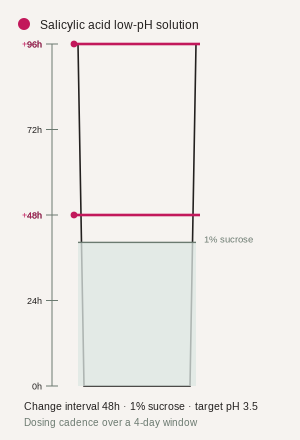
Salicylic acid low-pH solution: 0.1 g/L, pH 3.5, for wilting-prone stems
· Published 2026-10-23 · Vase solutions
Salicylic acid is the recipe for stems that lose water faster than they can take it up — sunflowers, stock, lilac. It does two things at once: it acidifies the water to pH 3.5 and it partially closes the stomata, cutting transpiration by roughly a fifth.
Sucrose 1 % Target pH 3.5 ±0.3 Change interval 48 h Available chlorine None mg/L Make at home Yes
| Component | Per litre | Role |
|---|---|---|
| Salicylic acid (pharmaceutical grade) | 0.1 g | acidifier and anti-transpirant — reduces stomatal water loss |
| Ethanol 40% (for dissolving the acid) | 2 mL | solvent only — no effect on vase life |
| White granulated sucrose | 10 g | energy substrate |
| Sucrose | 1 % | Target pH 3.5 (±0.3) |
| Change interval | 48 h | Available chlorine: None |
| Make at home | Yes | salicylic acid itself is weakly antimicrobial at this pH; supplement with a 48-hour water change |
Dissolve it properly or it does nothing
Salicylic acid is poorly soluble in cold water — about 2 g per litre at 20 °C, and far less in the hard water most taps supply. Dissolve the 0.1 g in 2 mL of 40% ethanol first, then add that to the litre. Undissolved crystals settle on the stem end and cause localised burning.
Do not substitute aspirin tablets. A 500 mg aspirin tablet contains about 450 mg of acetylsalicylic acid plus binder, and the binder is a food source for bacteria.
- Dissolve 0.1 g salicylic acid in 2 mL of 40% ethanol before adding to water.
- Use soft or distilled water if your tap water is above 200 mg/L calcium carbonate.
- Stir until no crystals remain on the base of the jug.
- Discard and remix if the solution turns cloudy — that is precipitation, not contamination.
What the low pH buys you
Most vase water in hard-water areas sits at pH 7.4–8.1. At that pH, calcium and magnesium ions precipitate inside the xylem and plug it mechanically. Dropping to pH 3.5 keeps those ions in solution and keeps the vessels open.
| Water pH | Xylem plugging at day 4 | Vase life, sunflower |
|---|---|---|
| 3.5 | minimal | 7 days |
| 4.5 | slight | 6 days |
| 6.0 | moderate | 5 days |
| 7.8 (hard tap) | severe | 3–4 days |
Which stems, and which to keep away
Use this recipe on sunflower, stock, lilac and delphinium. Do not use it on hydrangea, whose petals absorb water directly and are damaged by low pH, or on gerbera, whose hollow stem is not helped by acidification.
Salicylic acid also suppresses ethylene synthesis slightly, which makes it a reasonable second choice for carnation when no commercial sachet is available.
- Good match: sunflower, stock, lilac, delphinium, carnation.
- Bad match: hydrangea, gerbera, leatherleaf fern.
- Keep out of reach of children — the concentrated acid is a skin irritant.
- Mix fresh every 48 hours; salicylic acid slowly oxidises in light.
0.1 g salicylic acid pre-dissolved in 2 mL of 40% ethanol, then 10 g sucrose, made up to 1 L