Leatherleaf fern: no end treatment, 48-hour changes, 10–14 days
· Published 2026-10-18 · Woody
Leatherleaf is a foliage, not a flower, and it is filed under 'no treatment' for the opposite reason to gypsophila: the frond is so tough and its transpiration so low that any end treatment is unnecessary work.
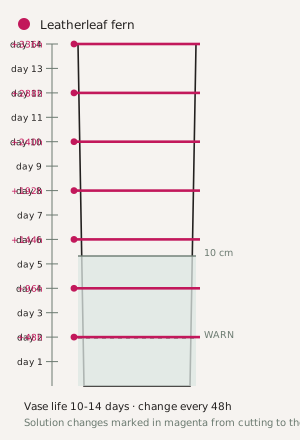
Vase range 10–14 days Recut 25 mm Water every 48 h Lignification 4 / 5 Ethylene sensitivity Low
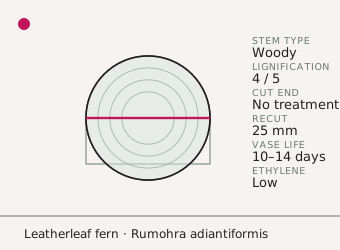
A plain 25 mm cut is the whole method
The leatherleaf rachis (the frond's central stem) is a thick, leathery structure with a dense vessel ring. It does not embolise easily, it does not crush easily and it does not need crushing to take up water. A single clean cut with sharp snips is both sufficient and safest.
What it does need is a cut in air, not under water — a submerged cut leaves the rachis surface wet and that is where the first rot appears.
- Cut 25 mm with sharp snips in air; do not cut under water.
- Never crush, sear or split the rachis.
- Strip the lower fronds so only the top three or four remain on each stem.
- Stand in 8–10 cm of water; deeper water rots the rachis base.
Ferns are a slow-uptake, slow-failure stem
The leatherleaf's failure mode is not the sudden collapse you see in a gerbera — it is a gradual browning from the frond tips over a week. That gives you time to react, and the reaction is almost always the same: recut and change the water.
| Symptom | Cause | Action |
|---|---|---|
| Tips brown evenly across all fronds | bacterial load | recut 25 mm, change water, rinse vase |
| One frond yellows and drops | physical damage in transit | remove that frond only |
| Leaflets drop when touched | ethylene from a neighbour | isolate; remove the source stem |
| Fronds curl inward | dry air, not water | move away from the vent; mist once daily |
Cool storage and the upside-down trick
Leatherleaf stores unusually well: a dry bunch held at 4–6 °C in the dark keeps for two to three weeks, which is why it is often bought well ahead of an event. Rehydrate it with a fresh 25 mm cut and two hours in cool water before use.
For arrangements where the fronds must arc downward, stand the bunch upside down in 5 cm of water for an hour first. The rachis is stiff enough that this sets a gentle curve you can then use.
- Store dry at 4–6 °C in the dark for up to three weeks.
- Rehydrate with a fresh cut plus two hours in cool water.
- Never store leatherleaf wet for more than 48 hours — the rachis blackens.
- For a downward arc, condition upside down in shallow water for one hour.
Keep away from
- storage over 24 hours with ageing carnation or delphinium