Parallel binding: 7–13 stems, tie at 22%, foam support, stems 1.1× the vase
· Published 2026-11-04 · Bouquet structures
The parallel bunch is the tightest and most architectural structure here: the stems never cross, they simply stand together in a narrow column. It is the fastest to build and the least forgiving of a badly chosen stem mix.
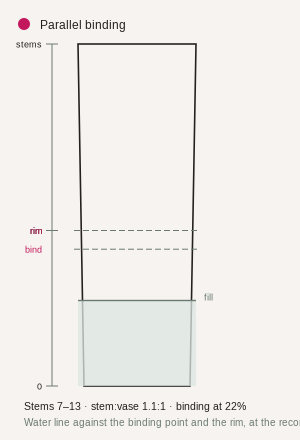
Parallel 0° Binding point 0.22 Support Floral foam Stem count 7–13 Stem : vase height 1.1
Parallel means parallel
In a parallel bunch the stems are laid side by side in one plane and bound at 22% of their length — much lower than a spiral. The visual result is a single narrow column of flowers at the top with a long, visible stretch of clean stem below.
The low binding point is the whole point: it keeps the column narrow for most of its length. Bind at 35% and the bunch immediately looks like a badly made spiral.
- Lay stems side by side in one plane; do not rotate the bunch as you add.
- Align the cut ends exactly — a parallel bunch shows every millimetre of mismatch.
- Bind at 22% of stem length with two wraps of raffia, tied at the back.
- 7–13 stems; beyond 13 the column becomes too wide to read as parallel.
Foam support and the tall-vase problem
Because the stems never cross, the bunch has no internal lattice to hold itself up, and a parallel column of 7–13 stems in a vase will lean as a unit. The standard fix is a small block of floral foam in the base of the vase, cut 20 mm wider than the column and soaked for 30 minutes first.
The foam has to be changed or at least rinsed every third day. Foam that has been in sugar solution for a week is a bacterial reservoir and will undo every other good practice in this archive.
| Support | Column lean at day 2 | Water clarity at day 4 |
|---|---|---|
| Foam block, rinsed every 3 days | none | clear |
| Foam block, not rinsed | none | cloudy, odour |
| Slotted grid | none | clear |
| No support | 8–12° | clear but stems splay |
Stem choice decides everything
A parallel bunch only works when all the stems are of similar stiffness. Mix one soft stem into a column of woody stems and it bends out of line within a day; mix one woody stem into a column of soft ones and the soft ones follow it.
The good combinations are the obvious ones: rose with eucalyptus, chrysanthemum with leatherleaf, carnation with gypsophila. Keep the sugar-hungry stems out — they need to be recut often and that is hard to do in a tightly bound parallel column.
- Vase height ≈ 90% of stem length; a parallel bunch sits low in the vase.
- Group by stiffness, never alternate stiff and soft.
- Avoid alstroemeria and lisianthus in this structure — they need frequent recuts.
- Cut all stems to the same length with a jig or a marked board, not by eye.