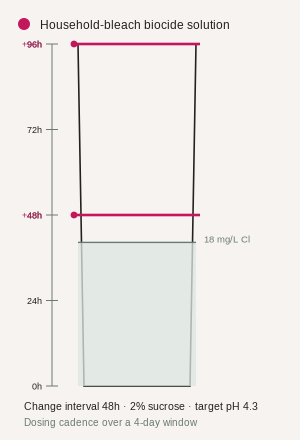
Household-bleach biocide solution: 0.35 mL/L bleach, 18 mg/L available chlorine
· Published 2026-10-21 · Vase solutions
This is the home recipe with a real biocide in it. The whole recipe stands or falls on the bleach measurement: at 0.35 mL per litre it works as well as a commercial sachet for the first 48 hours, and at 3.5 mL per litre it bleaches the petals.
Sucrose 2 % Target pH 4.3 ±0.3 Change interval 48 h Available chlorine 18 mg/L Make at home Yes
| Component | Per litre | Role |
|---|---|---|
| Household bleach, 5.25% sodium hypochlorite | 0.35 mL | biocide — oxidises bacteria and biofilm |
| White granulated sucrose | 20 g | energy substrate |
| Citric acid (food grade) | 0.15 g | acidifier, also buffers the chlorine |
| Sucrose | 2 % | Target pH 4.3 (±0.3) |
| Change interval | 48 h | Available chlorine: 18 mg/L |
| Make at home | Yes | sodium hypochlorite, target 15–20 mg/L available chlorine at mixing |
Measure the bleach, do not estimate it
Household bleach is sold at 5.25% sodium hypochlorite in most markets, and 0.35 mL of it in 1 litre of water gives roughly 18 mg/L of available chlorine. That is a working concentration: enough to hold the bacterial load below the plugging threshold for two days, low enough that petal tissue is unharmed.
Use a graduated syringe or a 1 mL measuring spoon. A 'splash' is roughly ten times the required dose.
- 0.35 mL of 5.25% bleach per litre — not per vase, per litre of water in that vase.
- If your bleach is 8.25% rather than 5.25%, use 0.22 mL/L instead.
- Add the bleach last, after the sugar and acid have dissolved.
- Never mix bleach with a commercial preservative — the bleach destroys the biocide and the surfactant.
Chlorine decays, which is why 48 hours and no more
Free chlorine in an open vase decays quickly. At 20 °C in a lit room, roughly half of the available chlorine is gone within 24 hours and essentially all of it within 48. That decay curve is the reason the interval is fixed at 48 hours rather than being a matter of taste.
| Hours after mixing | Estimated available chlorine | Bacterial control |
|---|---|---|
| 0 | 18 mg/L | full |
| 12 | 11 mg/L | full |
| 24 | 7 mg/L | partial |
| 36 | 3 mg/L | poor |
| 48 | below 1 mg/L | none — change now |
Safety and the stems it suits
This recipe suits roses, carnations, chrysanthemums, alstroemeria and gypsophila — the stems the archive rates as medium or high sugar users with a moderate bacterial problem. It is a poor match for hollow-stemmed flowers because the bleach cannot reach inside the tube.
Note the handling rules: never mix bleach with an acid in concentrated form (chlorine gas is released), so always add the bleach to the already-diluted and acidified vase water, never the reverse, and never into the concentrating jar.
- Always add bleach to a full vase of diluted, acidified water — never to a concentrate.
- Keep the mixed solution away from children and pets; label the jug.
- Do not use on hydrangea, gerbera or delphinium.
- Rinse the vase thoroughly before using it for a commercial preservative later.
20 g sucrose + 0.15 g citric acid + 0.35 mL of 5.25% bleach in 1 L of water