Lilac: hammer the woody base, then change water daily, 5–9 days
· Published 2026-10-13 · Woody
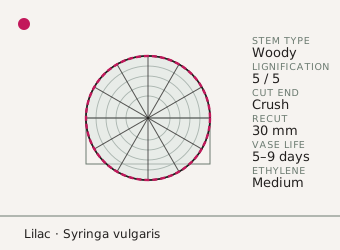
Lilac is the archive's most lignified stem at 5/5, and the only one where the recommended cut treatment is physical rather than thermal: you break the wood open so that water can reach vessels a clean cut would never wet.
Vase range 5–9 days Recut 30 mm Water every 24 h Lignification 5 / 5 Ethylene sensitivity Medium
Hammering: 50 mm of smashed wood, not a nick
A lilac stem's outer 3 mm is nearly impermeable bark. A clean cut exposes only the vessels at the cut face, and those alone cannot supply a flowering branch. Smashing the bottom 50 mm with a hammer opens hundreds of vessels along the length of the damaged section.
Use a hammer or the back of a heavy knife. Flatten the base to roughly twice its original diameter, then put it straight into water.
- Recut 30 mm at 45° first, then smash the next 50 mm.
- Smash, do not split — a single clean split opens fewer vessels than a bruised, frayed base.
- Do not hammer more than 60 mm; the frayed wood sheds into the vase.
- An alternative for a single stem is a 20-second boiling-water dip, but hammering works better on lilac.
- Rinse the frayed base under a tap before it goes in the vase.
Lilac is a heavy drinker with a foul base
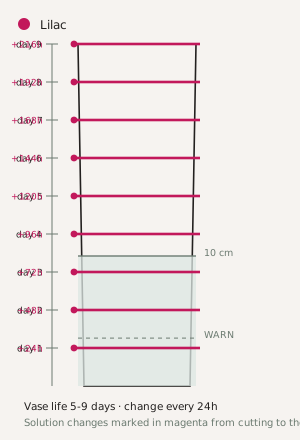
The damaged wood that makes uptake possible also releases a large amount of phenolic material into the water. That is why lilac needs a daily change even though its vase life is short: the solution is spent within a day.
| Change interval | Vase life at 20 °C | Water appearance |
|---|---|---|
| 24 h | 8–9 days | clear to faintly amber |
| 48 h | 6 days | amber, woody smell |
| 72 h | 4 days | dark, stem base slippery |
| no change | 3 days | brown, foul |
Peel the bark and cut the leaves back
Lilac responds to the removal of the lower bark as well as to hammering. Strip the outer bark from the bottom 60 mm with a knife — this exposes the phloem and the outer vessel ring along the whole submerged length.
Leaves are the other lever: lilac foliage transpires heavily and a leafy branch will out-drink its own uptake capacity. Remove all but the top three or four leaf pairs.
For forced lilac out of season, the stems have less stored sugar and the realistic ceiling drops to about five days.
- Strip the outer bark from the bottom 60 mm with a knife.
- Leave only the top three or four leaf pairs on each stem.
- Change water daily and rinse the vase — lilac phenolics stain glass.
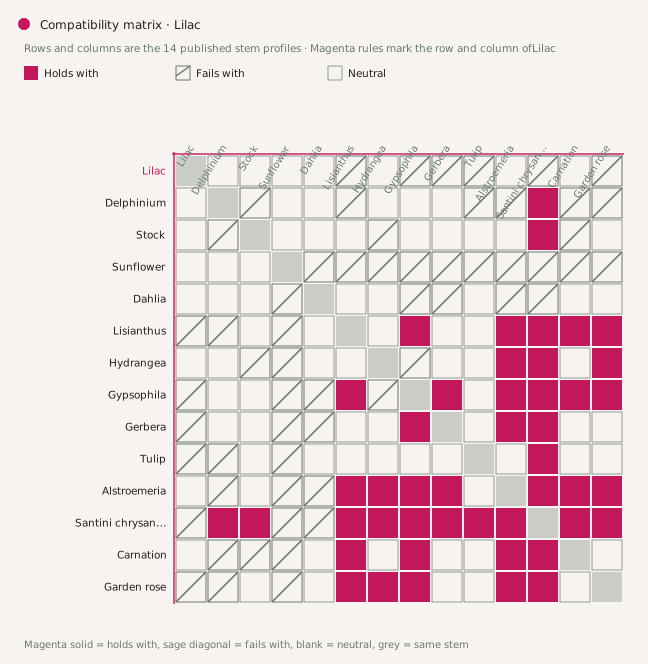
- Do not store lilac below 4 °C; the florets brown.
Keep away from
- confined rooms
- other stems' ageing foliage