Hard-water acidification solution: 0.5 g/L citric acid for tap water over 200 mg/L
· Published 2026-10-29 · Vase solutions
If your tap water is hard, most of the vase-life advice written elsewhere quietly fails. This recipe is the correction: more acid than the baseline, so the chelation has something left over after it has dealt with the water itself.
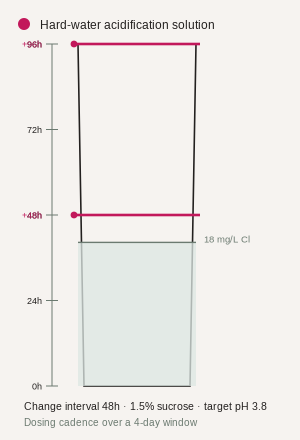
Sucrose 1.5 % Target pH 3.8 ±0.3 Change interval 48 h Available chlorine 18 mg/L Make at home Yes
| Component | Per litre | Role |
|---|---|---|
| Citric acid (food grade) | 0.5 g | chelates calcium and magnesium so they stay in solution |
| White granulated sucrose | 15 g | energy substrate |
| Household bleach, 5.25% sodium hypochlorite | 0.35 mL | biocide |
| Sucrose | 1.5 % | Target pH 3.8 (±0.3) |
| Change interval | 48 h | Available chlorine: 18 mg/L |
| Make at home | Yes | sodium hypochlorite, target 15–20 mg/L available chlorine |
How to tell whether you need this
You need this recipe if your water leaves a chalky film on a glass left to dry, if soap lathers poorly, or if you can look up a calcium carbonate figure above 200 mg/L from your supplier. Below that figure the baseline recipe at 0.15 g/L citric acid is enough.
Hard water does its damage mechanically rather than chemically: calcium carbonate precipitates inside the xylem at pH above about 6, and the precipitate is what plugs the stem.
- Check your supplier's calcium carbonate figure, usually quoted in mg/L or as German degrees of hardness.
- Above 200 mg/L: use this recipe. 100–200 mg/L: use the baseline with 0.25 g/L citric acid.
- Below 100 mg/L: the baseline recipe is correct and this one is over-acidified.
- A chalky film on a dried glass is the quick field test.
The numbers, measured on hard tap water
The table below is the comparison most people never see: the same rose, the same routine, three different waters. The distilled-water column shows how much of the vase-life loss attributed to 'bad flowers' is actually water chemistry.
| Water source | CaCO3 (mg/L) | Vase life, garden rose, 24 h changes |
|---|---|---|
| Distilled | 0 | 8 days |
| Soft tap | 80 | 7–8 days |
| Medium tap | 180 | 7 days |
| Hard tap | 320 | 5–6 days |
| Hard tap + this recipe | 320 | 7 days |
Mixing order matters here
Dissolve the citric acid in the full litre of water first and let it stand for two minutes so the chelation completes, then add the sucrose, then the bleach last. Adding bleach to water that still holds free calcium produces a brief chlorine demand that eats part of your biocide.
If the solution smells strongly of chlorine after mixing, the water has a high chlorine demand and you should increase the bleach to 0.5 mL/L.
- Citric acid first, wait two minutes.
- Sucrose second, stir to clear.
- Bleach last, stirred in gently — do not shake.
- Never use this recipe on hydrangea; the low pH damages the petals it relies on.
15 g sucrose + 0.5 g citric acid + 0.35 mL bleach in 1 L of water