Garden rose: 25 mm slant cut, 24-hour water changes, 5–7 days
· Published 2026-08-21 · Woody
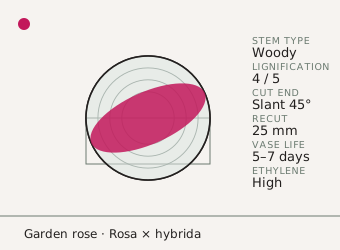
The garden rose is the archive's reference woody stem. Its 4/5 lignification rating means the vase is won or lost at the cut end, not at the petals — a blocked xylem here shows up as a nodding head roughly 36 hours before any petal symptom.
Vase range 5–7 days Recut 25 mm Water every 24 h Lignification 4 / 5 Ethylene sensitivity High
What the 4/5 lignification rating means in practice
A garden rose stem carries roughly 60% of its water through the outer ring of vessels and 40% through the woody core. Once that core is cut and exposed to air for more than about 40 seconds, an air embolus forms and travels up to the head. This is why the 25 mm recut is specified rather than a token trim: you are removing the whole embolised segment, not just tidying the end.
At lignification 4 the stem resists crushing well, so a clean pair of bypass pruners is enough. Anvil pruners bruise the outer ring and that bruise is where the first bacterial mat forms.
- Recut 25 mm at 45°, immediately before the stem goes into water — not 10 minutes earlier.
- Strip every leaf that would sit below the waterline; a single submerged leaf raises the bacterial count by an order of magnitude in 24 hours.
- Hold the stem under running room-temperature water for the cut if you cannot do it in the vase.
- Never let the cut end dry between the bucket and the arrangement.
The 24-hour water change is a floor, not a target
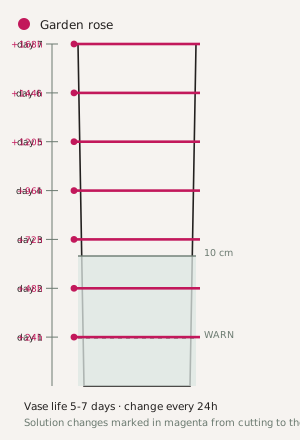
At 22 °C a rose solution reaches a bacterial load of about 10^6 CFU/mL in 30 hours if the water is unchanged. The 24-hour interval keeps the count an order of magnitude below that, which is the difference between a 7-day rose and a 5-day rose.
Change the water, do not top it up. Topping up leaves the biofilm on the vase wall intact and the biofilm is the reservoir, not the water.
| Hours since cutting | Typical bacterial load (CFU/mL) | Observable symptom |
|---|---|---|
| 0–12 | 10^3 | none |
| 12–24 | 10^4 – 10^5 | water faintly cloudy |
| 24–36 | 10^6 | stem end slippery, neck softens |
| 36–48 | 10^7 | head nods, outer petals blue-shift |
Handle the ethylene window first, then the hygiene
Roses rate high on ethylene sensitivity, but the damaging window is narrow: the first 24 hours after the bud opens. After that the same concentration will cost you petal colour but not stem life.
The practical order is: get the stem into clean water within two minutes, keep it below 5 °C for the first four hours if you can, then move it to the display position away from fruit and heaters.
- Treat with a commercial ethylene action inhibitor (1-MCP) or a silver-thiosulphate pulse if the roses must travel.
- Keep the display position above 0.5 m from any fruit bowl — a single ripe banana is enough to blue the outer petals overnight.
- Discard any stem whose head nods on arrival; it is already past the point where a recut helps.
Companions and antagonists
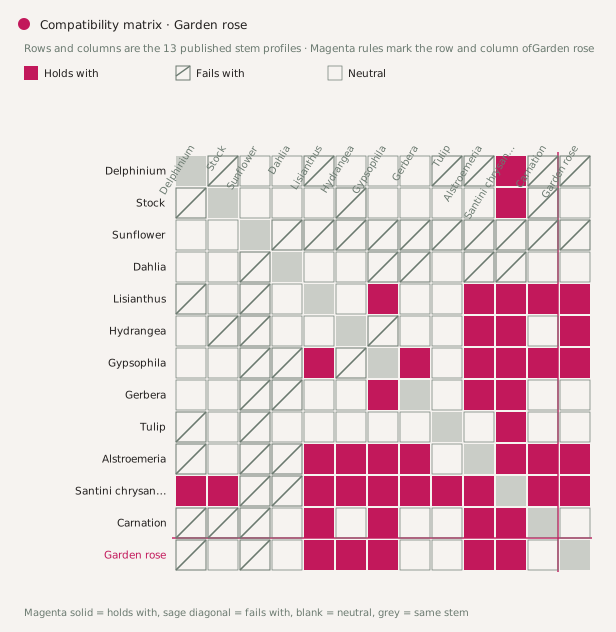
Garden roses hold well with alstroemeria, Santini chrysanthemum, gypsophila and eucalyptus. The pairings that fail — sunflower, delphinium, lilac — fail for three different reasons: water competition, ethylene release, and solution fouling. The compatibility matrix at the foot of this page flags which mechanism applies to each pairing.
Keep away from
- ripe fruit bowls within 2 m
- cigarette smoke
- unvented gas heaters
- crushed or yellowing leaves left on the stem
- exhaust from a cold box shared with produce